Engineering
Fit-for-purpose solutions that meet project objectives and comply with international codes and standards.
Explore discipline →
Who we are
Teknik Engineering Practice (TEP) is dedicated to delivering world-class Engineering, Procurement, and Construction solutions through systematic engineering principles, international standards, proven procedures, and industry best practices.
Our approach combines engineering excellence, technical integrity, innovation, and professional competency to achieve the highest standards of safety, quality, reliability, efficiency, and sustainability.
Read our overview →Core disciplines
From concept to handover, TEP brings disciplined engineering, assured procurement, and safe construction together.
Fit-for-purpose solutions that meet project objectives and comply with international codes and standards.
Explore discipline →Timely and cost-effective acquisition of quality materials, equipment, and professional services.
Explore discipline →Safe, efficient execution aligned with design intent, quality standards, and operational readiness.
Explore discipline →How we work
People, assets, and environment.
Quality in every process and deliverable.
Best practices and continuous improvement.
Responsible practice for a better future.
Featured Ebooks
Explore digital handbooks, templates, and toolkits that help EPC work become more systematic, safe, and measurable.
Go to Product Page →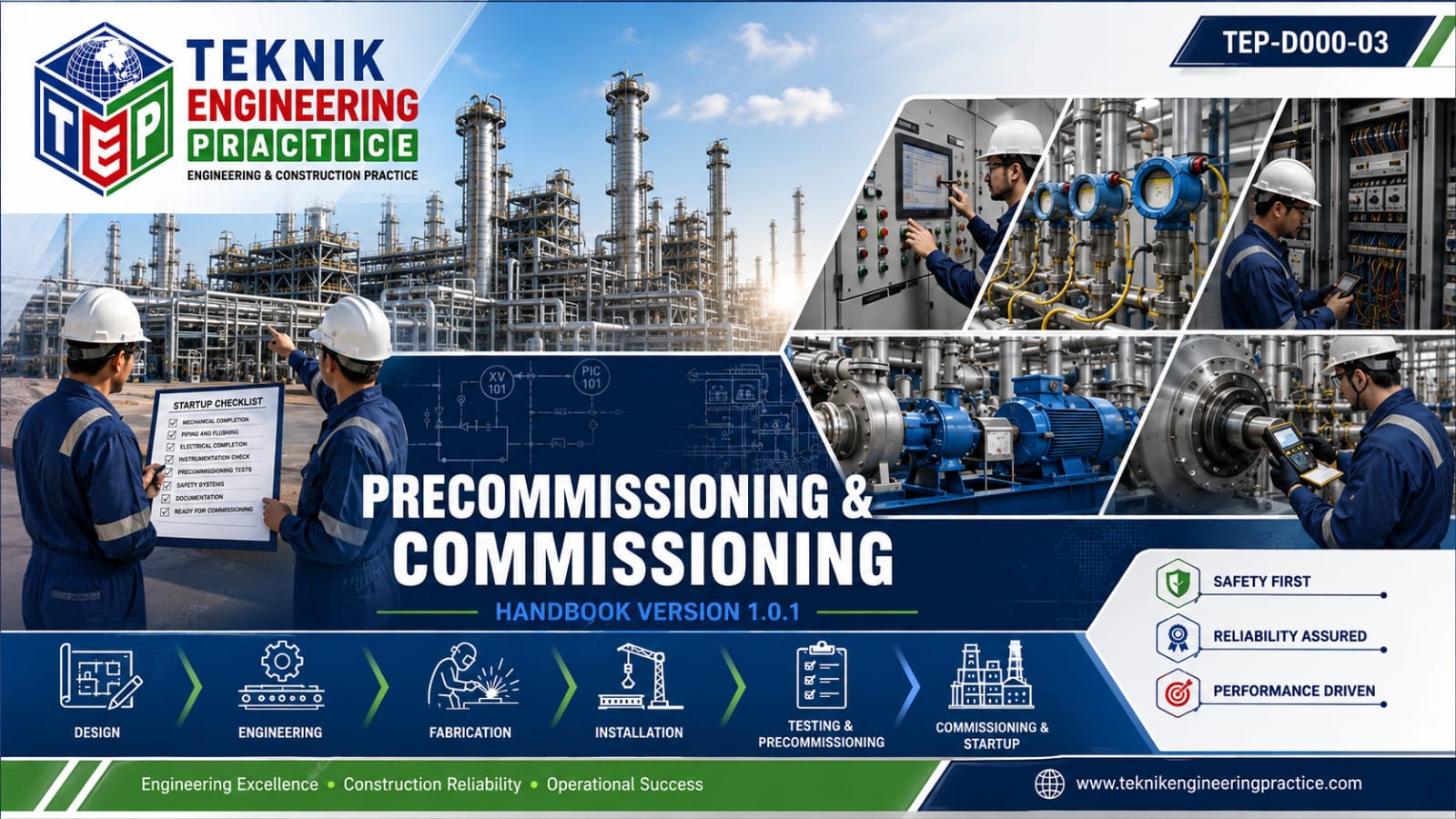
The *Precommissioning & Commissioning Handbook Version 1.0.1* provides an integrated framework for completion management and commissioning of industrial facilities across oil and gas, petrochemical, chemical, power, water and wastewater, mining, manufacturing, offshore, and infrastructure/marine sectors. It is designed to guide project teams through structured preparation, disciplined execution, and reliable handover to operations. The handbook covers commissioning philosophy, systemization, mechanical completion verification, flushing and cleaning, hydrostatic and pneumatic testing, static and rotating equipment readiness, electrical systems, instrumentation and control, fire and gas systems, emergency shutdown (ESD), utilities, specialty cleaning, start-up sequencing, performance testing, reliability runs, HSE requirements, PTW/LOTO/SIMOPS, preservation, maintenance, handover, documentation, vendor packages, procurement interfaces, and heavy installation support. Technical content includes calculation notes, worked examples, material and equipment requirements, inspection and test plan (ITP) concepts, field release criteria, commissioning forms, maintenance frequency guidance, inspection records, sector application matrices, and technical flow diagrams. These resources provide both engineering rigor and practical usability, ensuring that commissioning activities are traceable, auditable, and aligned with project specifications. The methodology emphasizes risk-based planning, progressive verification, and quality gate management. By linking procedures, checklists, test records, and certificates to clear handover gates, the handbook ensures that no system proceeds to the next phase without controlled acceptance evidence. The lifecycle perspective extends from design and fabrication through shipping, installation, construction, completion, commissioning, and maintenance. Sector applications demonstrate how commissioning priorities adapt to different industrial environments, ensuring readiness and reliability across diverse projects. The objective is to deliver a professional, traceable, and field-usable reference that helps project teams reduce late rework, protect equipment, improve readiness decisions, and establish a credible technical baseline for operations and maintenance. By combining structured methodology, technical evidence, and progressive handover practices, the *Precommissioning & Commissioning Handbook* equips teams with a clear roadmap for safe start-up and reliable long-term operation.
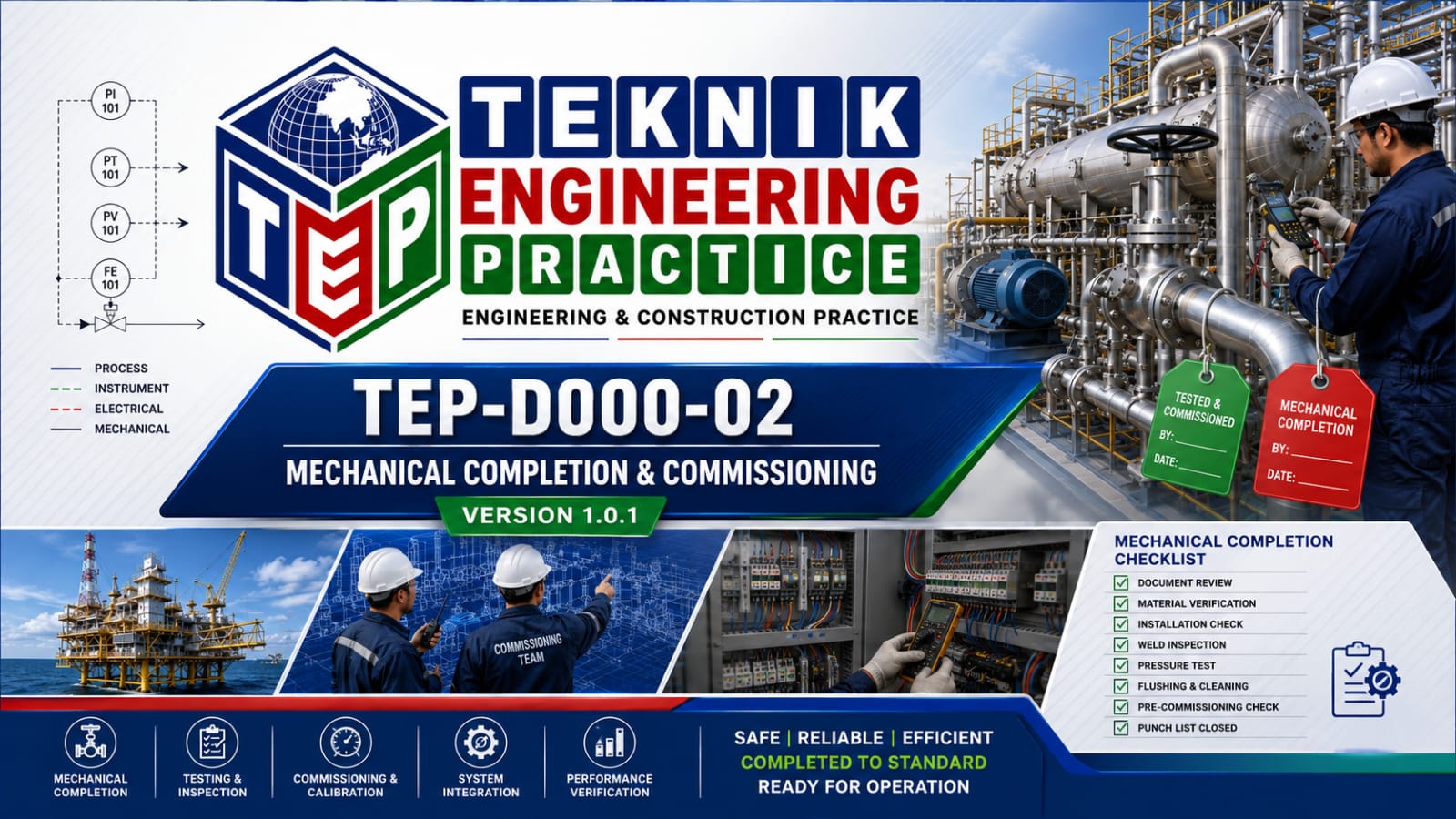
The *Mechanical Completion & Commissioning Handbook* presents an integrated methodology for managing the transition of industrial facilities from late construction through ready-for-start-up and operational handover. It establishes a structured framework based on systemization, tag-level verification, inspection and test records, controlled punch management, formal certificates, and progressive transfer of custody. The approach ensures that equipment and systems are correctly installed, preserved, cleaned, tested, safe to energize, and suitable for functional operation. Technical coverage includes mechanical installation and alignment, piping line checking, pressure testing, flushing, and reinstatement. It addresses vessels, tanks, exchangers, rotating equipment solo runs, vibration checks, valves, and relief devices. Electrical completion and energization interfaces are integrated with instrumentation calibration, loop checks, control-system and safety-system functional testing. Utility preparation, nitrogen and chemical cleaning, start-up sequencing, performance testing, reliability verification, and turnover dossier preparation are also included. The handbook provides calculation notes, worked examples, material and procurement controls, inspection forms, commissioning forms, maintenance frequency guidance, reliability concepts, industrial-sector application matrices, and visual engineering diagrams. These resources support both technical rigor and practical usability, ensuring that commissioning activities are traceable, auditable, and aligned with project requirements. The lifecycle perspective extends from design and fabrication through shipping, installation, construction with heavy-equipment interfaces, completion, commissioning, and maintenance. Sector applications include oil and gas, petrochemical, chemical, power generation, water and wastewater, mining, manufacturing, offshore, and infrastructure/marine facilities. The objective is to deliver a professional, traceable, and field-usable reference that helps project teams reduce late rework, protect equipment, improve readiness decisions, and establish a credible technical baseline for operations and maintenance. By combining structured methodology, technical evidence, and progressive handover practices, the *Mechanical Completion & Commissioning Handbook* equips teams with a clear roadmap for safe start-up and reliable long-term operation.
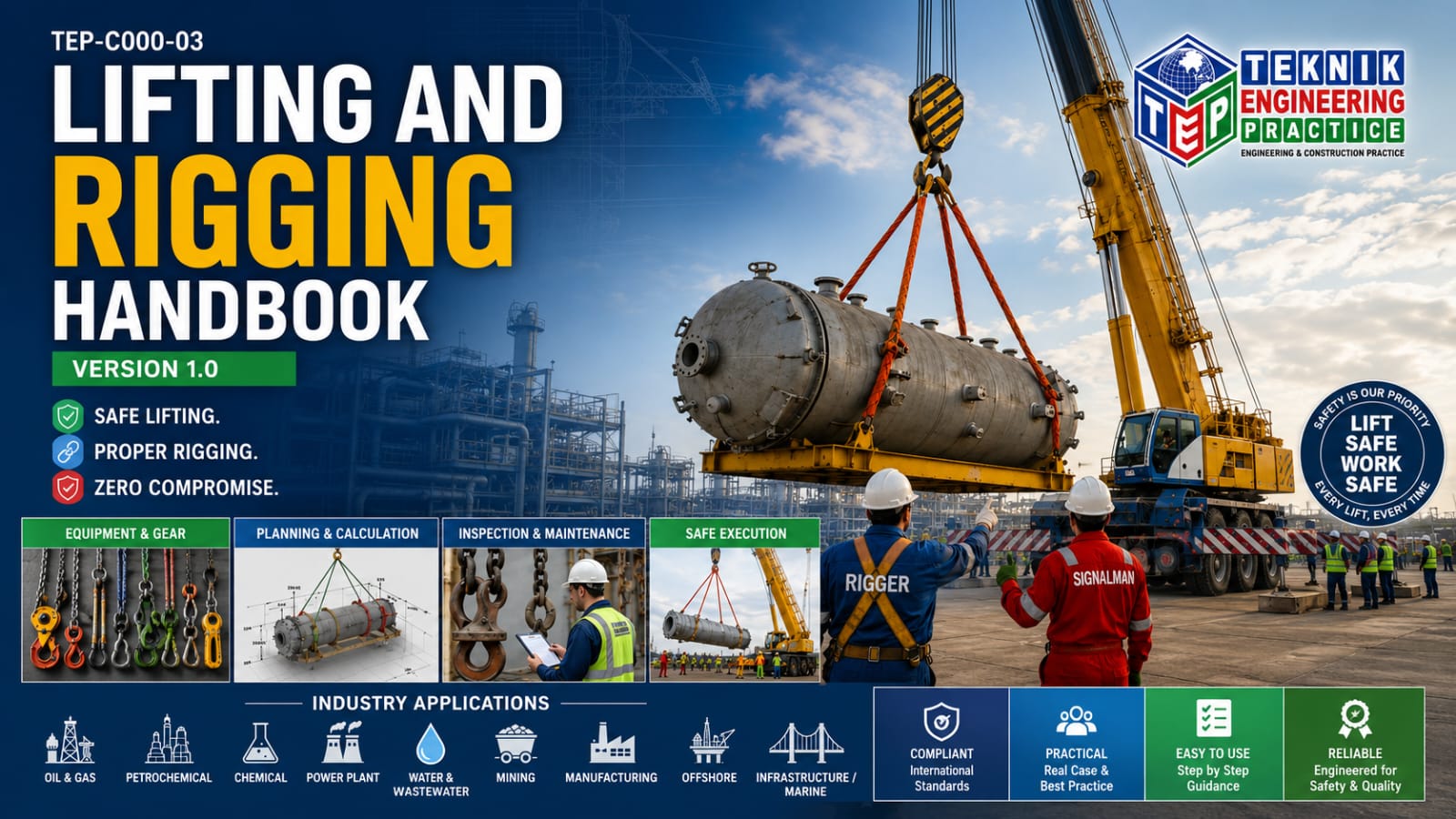
The *Lifting and Rigging Handbook Version 1.0* is a comprehensive professional reference for industrial lifting planning, engineering, execution, inspection, and lifecycle management. It provides structured guidance for lift classification, JSA/TRA and permits, lifted weight determination, center of gravity and pick points, crane selection, load charts, ground bearing and outrigger support. It also covers hooks, blocks, hoist ropes, wire rope, chain and synthetic slings, shackles, rigging hardware, spreader and lifting beams, padeyes, lifting lugs, sling angles, hitches, and specialized lifts including critical, tandem, upending, offshore, and personnel lifts. The handbook integrates engineering equations with field controls. Core calculations include center-of-gravity moments, sling-leg tension, two-support load sharing, crane utilization, and average bearing pressure. These are paired with material and specification controls, technical tables, inspection and test plan (ITP) concepts, field release records, maintenance frequencies, construction workflow diagrams, and structured checklists. Practical implementation emphasizes risk-based planning, communication protocols, inspection discipline, maintenance practices, procurement, commissioning, emergency response, QA/QC, and digital rigging registers. Sector applications include oil and gas, petrochemical, power, mining, manufacturing, offshore, marine, and infrastructure projects. The handbook highlights the importance of traceability, competent personnel, calibrated equipment, hold-point discipline, and documented acceptance evidence. By combining engineering theory, field practices, and regulatory compliance, it ensures that lifting operations are executed safely, efficiently, and in alignment with industry standards. The standards framework references authoritative requirements checked in August 2026, including ISO 12480-1:2024, relevant ASME B30 volumes, ASME BTH-1, OSHA crane and rigging requirements, ISO wire-rope and crane-inspection standards, and Indonesian K3 lifting-equipment regulations. Project-specific engineering and manufacturer instructions remain controlling for actual operations. By integrating structured workflows, technical rigor, and visual learning tools, the *Lifting and Rigging Handbook Version 1.0* equips project teams with a consistent, auditable, and evidence-based lifting methodology. Its objective is to reduce quality risks, prevent rework, improve safety, and ensure reliable, technically compliant lifting operations across diverse industrial environments.
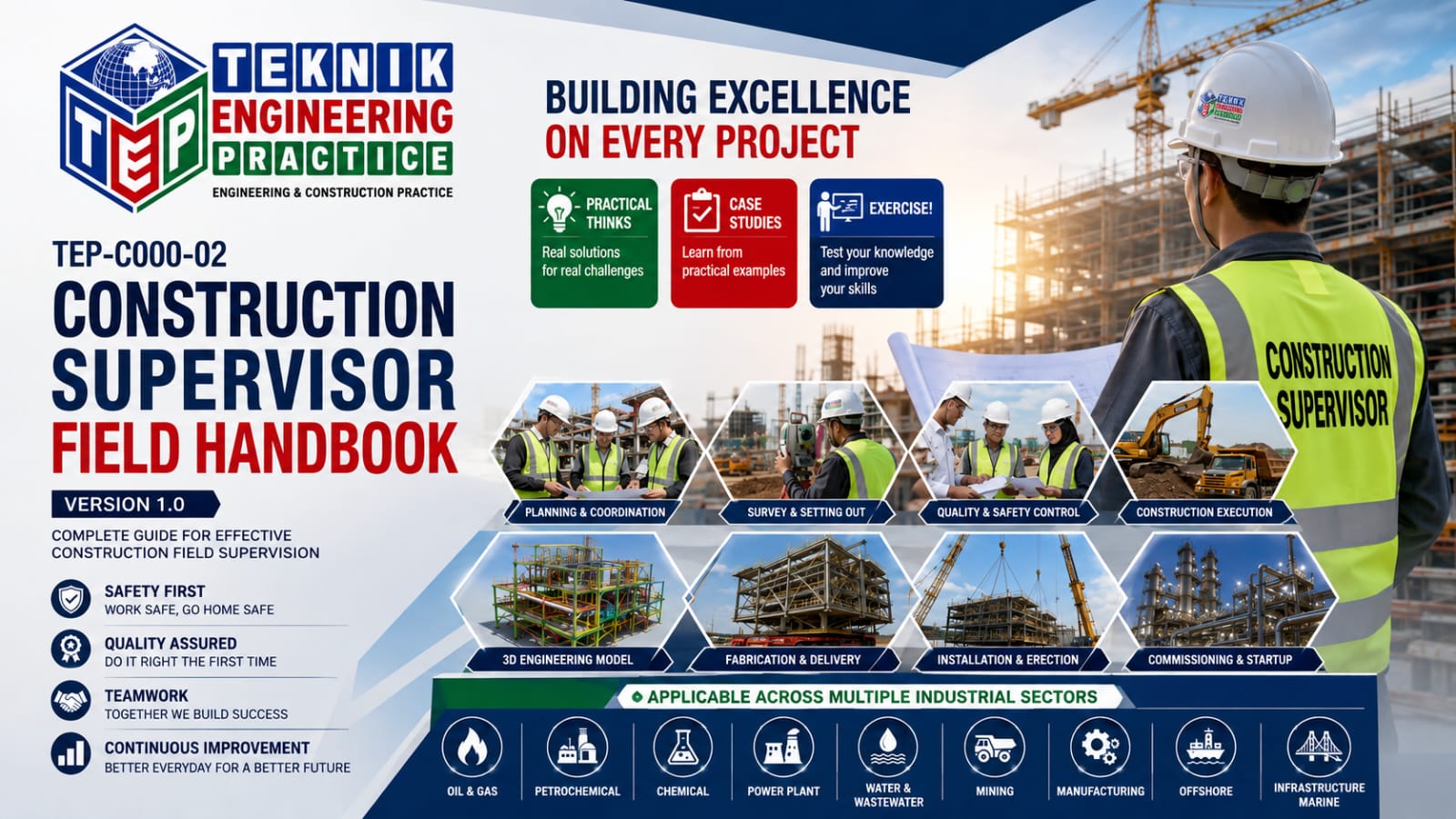
The *Construction Supervisor Handbook* provides a comprehensive field reference for supervisors responsible for multi-discipline industrial construction. It establishes a structured framework to guide supervision responsibilities, workface planning, document control, site logistics, surveying, civil and structural works, heavy lifting, mechanical and piping installation, electrical and instrumentation activities, protective coatings, QA/QC, HSE, productivity, material control, pre-commissioning, commissioning support, completion, and reliability transfer. Technical content includes first-principle calculation notes, worked examples, material and equipment controls, inspection and test plan (ITP) logic, field release practices, common records, maintenance and preservation frequencies, lifecycle diagrams, and supervisor decision points. These resources are designed to provide supervisors with a consistent method for turning approved engineering into safe, traceable, and high-quality installed work. The handbook emphasizes the importance of supervision discipline, ensuring that construction activities are linked to approved drawings, specifications, schedules, permits, and inspection points. It highlights risk management, safety leadership, and quality assurance as core responsibilities of the field supervisor. By integrating technical controls with practical checklists and decision gates, the handbook supports reliable execution and progressive acceptance of construction deliverables. An industrial application matrix is included to show how supervision priorities vary across process plants, utilities, mining, manufacturing, offshore, and infrastructure environments. This matrix helps supervisors adapt their focus depending on sector-specific risks, materials, and construction methods. The appendices provide reusable templates for inspection requests, material reports, NCRs, punch lists, test packages, and handover records. These tools ensure traceability, compliance, and efficient project close-out. Designed as a professional ready-to-print reference, yet editable for project-specific tailoring in Microsoft Word, the *Construction Supervisor Handbook* equips field leaders with practical guidance, technical rigor, and adaptable tools to strengthen supervision consistency, protect people and assets, and support complete, auditable handover to commissioning and operations.

The *Offshore Platform Fabrication Handbook* presents a comprehensive framework for managing fabrication activities with emphasis on fixed steel jacket and topsides projects, while retaining principles applicable to modular offshore and marine structures. It integrates engineering inputs, materials and procurement control, cutting and forming, fit-up and welding, non-destructive testing (NDT), coating, structural assembly, lifting, load-out, transportation, offshore installation, commissioning, QA/QC, and long-term integrity into one lifecycle system. Technical content includes calculation notes, worked examples, material-control methods, inspection and test plan (ITP) concepts, field-release requirements, inspection forms, maintenance and reliability guidance, industrial application matrices, and equipment/material workflows. The intent is to provide a practical bridge between design documentation and executable field controls, ensuring that fabricated assets are technically correct, traceable, and ready for safe installation and operation. The handbook highlights the importance of traceability, change control, competent personnel, calibrated equipment, hold-point discipline, temporary works engineering, weight control, HSE management, and completion records. These principles are essential to protecting structural integrity and ensuring readiness for transport, offshore installation, and commissioning. Extensive appendices provide reusable templates for design basis development, material requisitions, fabrication inspection, pile driving, heavy lifting, subsea installation, pipeline pre-commissioning, electrical energization, instrument calibration, emergency drills, corrosion monitoring, preventive maintenance, spare parts, and final print-ready quality checks. These resources are designed to support both field execution and management oversight, offering a balance between technical rigor and practical usability. By combining structured workflows, inspection focus, and visual learning tools, the *Offshore Platform Fabrication Handbook* equips professionals with the knowledge to manage offshore fabrication safely, efficiently, and in compliance with industry standards. Its overall objective is to establish a consistent execution system that improves readiness, minimizes rework and delay, strengthens traceability, and supports reliable handover from fabrication to installation and operation.

The *Offshore Engineering Handbook* presents a complete and practical overview of offshore engineering, covering the entire lifecycle from concept selection through decommissioning. It treats fixed steel jackets, topsides, FPSOs, subsea production systems, pipelines, risers, moorings, process systems, mechanical equipment, electrical distribution, instrumentation, telecommunications, safety systems, and marine utilities as parts of one integrated facility. Engineering theory is supported by calculation notes, worked examples, material and equipment lists, design-driver tables, inspection checklists, ITP concepts, commissioning forms, maintenance and reliability guidance, integrity-management principles, and industrial-sector application matrices. Temporary conditions such as lifting, loadout, transportation, and installation receive the same level of attention as the final operating condition, ensuring that risks and constraints are managed throughout the project lifecycle. The handbook emphasizes lifecycle constructability, readiness, and safe transition into live operation. It highlights the importance of inspection evidence, material traceability, and progressive verification, ensuring that offshore projects are executed with technical rigor and documented acceptance. Extensive appendices provide reusable templates for design basis development, material requisitions, fabrication inspection, pile driving, heavy lifting, subsea installation, pipeline pre-commissioning, electrical energization, instrument calibration, emergency drills, corrosion monitoring, preventive maintenance, spare parts, and final print-ready quality checks. These resources are designed to support both field execution and management oversight, offering a balance between technical detail and practical usability. By combining structured workflows, inspection focus, and visual learning tools, the *Offshore Engineering Handbook* equips professionals with the knowledge to manage offshore facilities safely, efficiently, and in compliance with industry standards. Its overall objective is to establish a consistent execution system that improves readiness, protects people and assets, minimizes rework and delay, strengthens traceability, and supports reliable handover from construction to operations and ultimately to decommissioning.
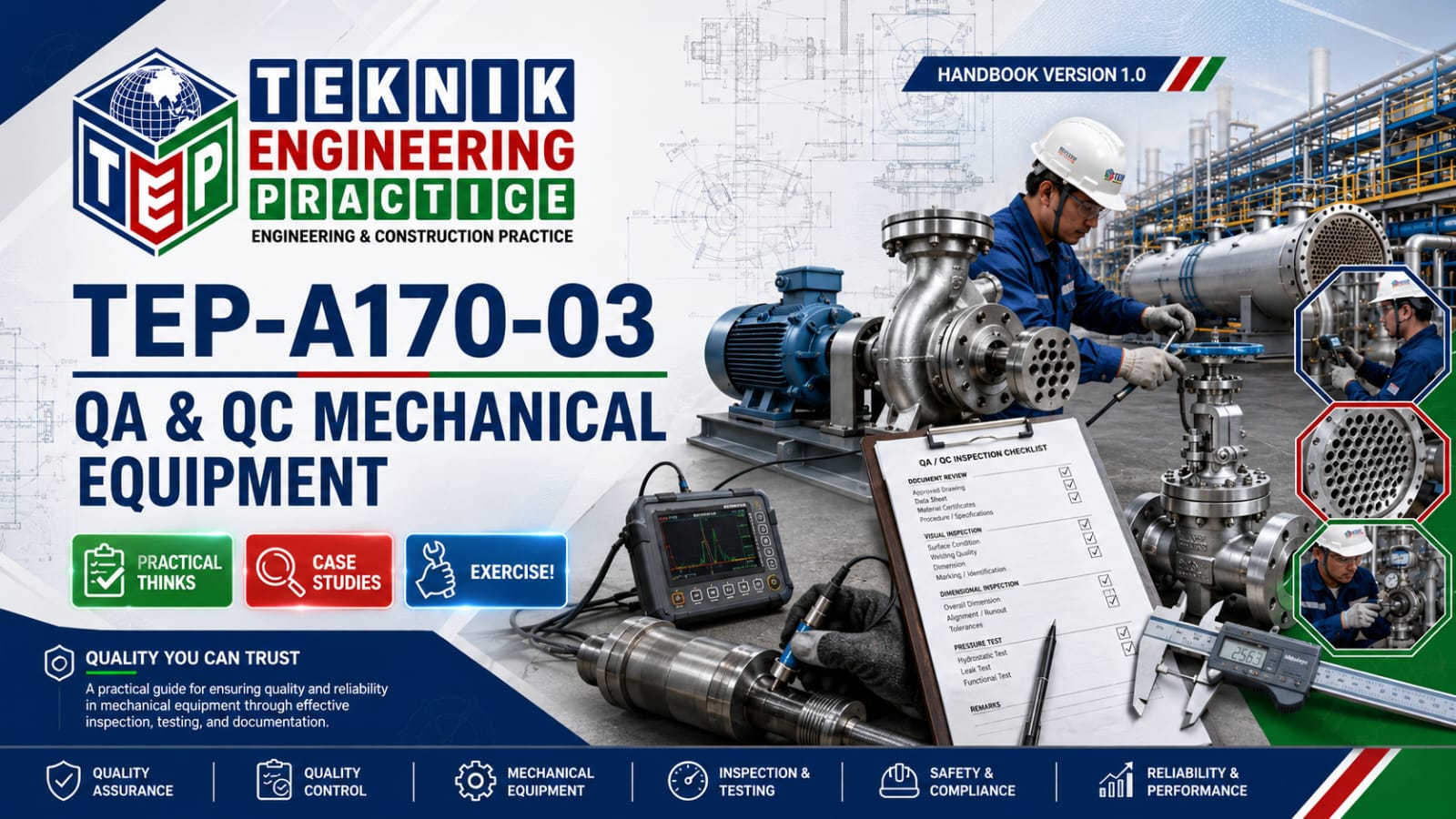
The *QA & QC Mechanical Equipment Handbook Version 1.0* provides a consolidated professional reference for inspection and quality management of rotating equipment, static equipment, valves, packaged skids, and associated mechanical construction activities. It integrates equipment engineering, vendor quality, fabrication, inspection and testing, site installation, commissioning, and reliability into a single lifecycle framework, ensuring consistency and traceability across all project phases. The handbook contains technical tables, checklists, sample material controls, inspection and test plan (ITP) logic, field release guidance, commissioning gates, maintenance-frequency recommendations, nonconformance controls, manufacturing record book (MRB) requirements, and worked calculation examples. Each chapter includes a dedicated visual plate combining an actual-style industrial inspection image with a 3D engineering schematic, plus a separate technical flow diagram to support both technical clarity and field learning. Industrial-sector application guidance covers oil and gas, petrochemical, chemical, power plants, water and wastewater, mining, manufacturing, offshore, infrastructure, and marine projects. The emphasis is on scalable QA/QC: inspection depth and documentation increase with safety consequence, equipment criticality, materials risk, fabrication complexity, transport exposure, installation difficulty, and performance sensitivity. The appendices provide ready-to-adapt forms for vendor document review, receiving inspection, rotating and static equipment inspection, alignment, grouting, welding and NDE, coating, FAT, shipping release, site storage, heavy lifting, mechanical completion, pre-commissioning, commissioning, NCR/CAR, punch lists, maintenance records, MDR indexing, and final turnover. These resources ensure that inspection activities are auditable, practical, and aligned with project requirements. Intended as a professional training resource and project execution manual, the *QA & QC Mechanical Equipment Handbook Version 1.0* equips teams with structured guidance, visual learning tools, and practical templates to achieve safe, complete, and technically compliant delivery of mechanical equipment, supporting reliable construction progress and disciplined project close-out.
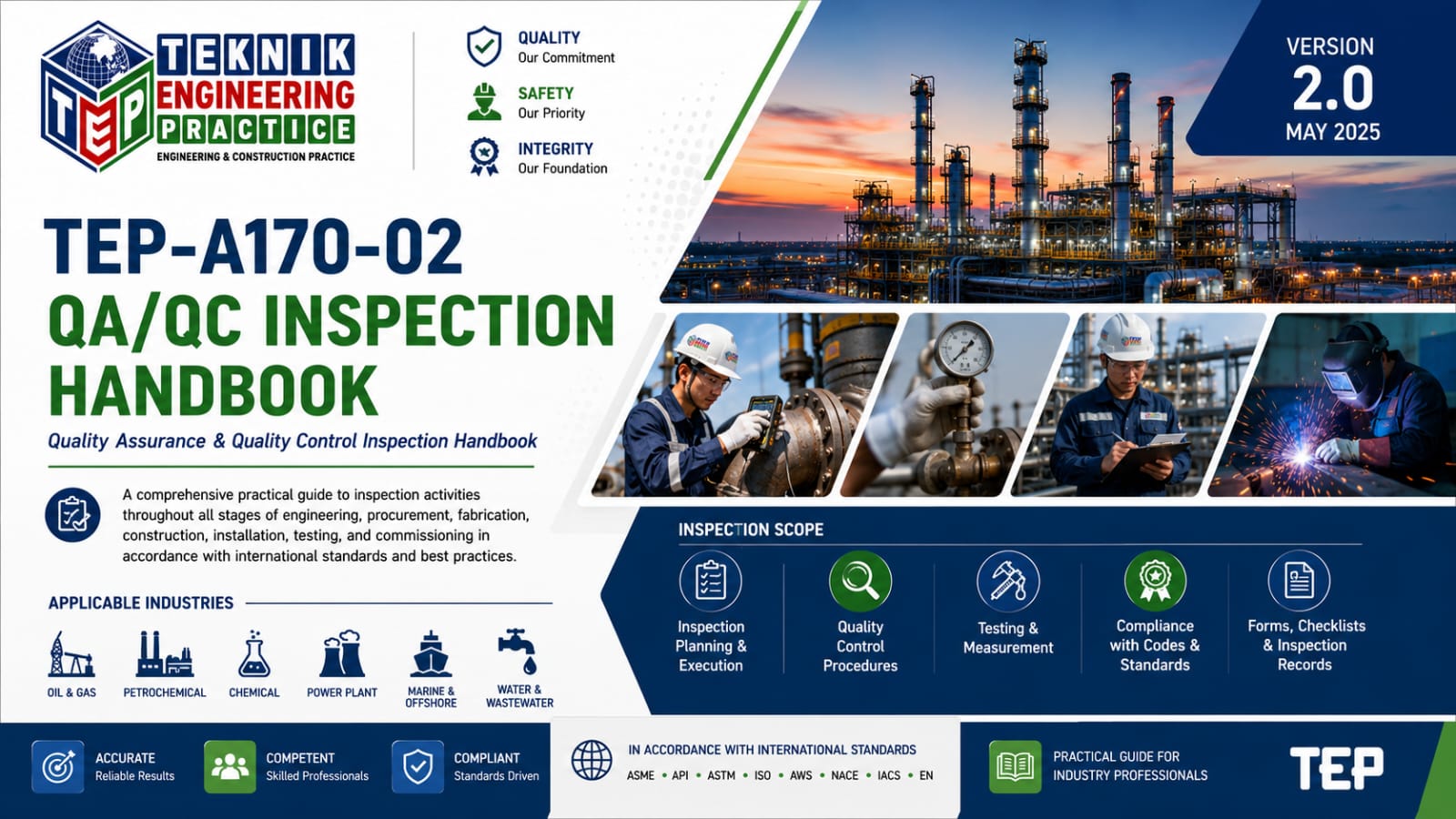
The *QA & QC Inspection Handbook* is a comprehensive reference for multidisciplinary engineering and construction projects, providing a controlled framework for inspection planning, execution, and documentation. It is designed to support project teams in achieving consistent decision-making, traceable quality evidence, reduced rework, and disciplined project close-out. The handbook begins with inspection planning, ITP development, and document control, then progresses through material receiving, traceability, vendor inspection, fabrication, welding, non-destructive testing (NDT), piping, mechanical equipment, civil works, concrete, structural steel, coatings, electrical systems, instrumentation, pressure testing, mechanical completion, pre-commissioning, commissioning, nonconformance control, and turnover dossiers. Each chapter defines purpose, interfaces, typical equipment, acceptance logic, minimum records, hold/witness point considerations, and practical checklists. Practical implementation is reinforced with worked field control notes, sector-specific application guidance, and templates for inspection requests, material reports, NCRs, punch lists, test packages, and handover records. These resources ensure that inspection activities are not only technically rigorous but also adaptable to real project conditions. This edition expands visual learning by adding distinct equipment images, 3D engineering drawings, and equipment/material control-cycle diagrams throughout the handbook. Images are scaled within A4 page limits and inserted without cropping, ensuring complete figures remain visible for training and field reference. The methodology emphasizes risk-based inspection planning, progressive verification, and quality gate management. By linking procedures, checklists, test records, and certificates to clear handover gates, the handbook ensures that no system or deliverable proceeds to the next phase without controlled acceptance evidence. Intended as a professional training resource and project execution manual, the *QA & QC Inspection Handbook* equips teams with structured guidance to strengthen inspection consistency, improve vendor performance visibility, and support safe, complete, and technically compliant delivery to construction and commissioning.